• Türkçe
  • English
Logo Logo
  • HOME
  • PRODUCTS
  • SERVICES
  • RESOURCES
    • Technical Articles
    • Academic Papers
    • News
  • ABOUT
  • CONTACT

Contact Info

  • E-MAIL info@spacrol.com
  • OFFICE HOURS Mon - Fri : 9:00 - 17:00
  • Address İhsan Doğramacı Blv. Üniversiteler Mah. No:31-20, ODTÜ TEKNOKENT Etkim 06800 Çankaya/Ankara

Additional Links

  • About
  • Academic Papers
  • Blog
  • Contact Us
  • Home
  • OUR SERVICES
    • COMPUTATIONAL FLUID DYNAMICS (CFD)
    • CONTROL SYSTEMS ENGINEERING
    • MANUFACTURING & ASSEMBLY
    • RESEARCH & DEVELOPMENT EXPERTISE
    • SOFTWARE DEVELOPMENT
    • SYSTEM DESIGN & PROTOTYPING
  • PRODUCTS
    • 1D4T
    • SACSTOR
    • Spherical Air Bearing

Connect With Us

Twist Optimization of a Helicopter Rotor Blade Using Support Vector Regression

  • Home
  • Academic Papers
  • Article
December 7 2024
  • Academic Papers

Twist Optimization of a Helicopter Rotor Blade Using Support Vector Regression

Authors: Emin B Ozyilmaz, Mustafa Kaya, Munir A Elfarra

Conference/Journal: Rotorcraft and Propeller Aerodynamic III

Publication Date: 08.06.2023

Read Now


Abstract:

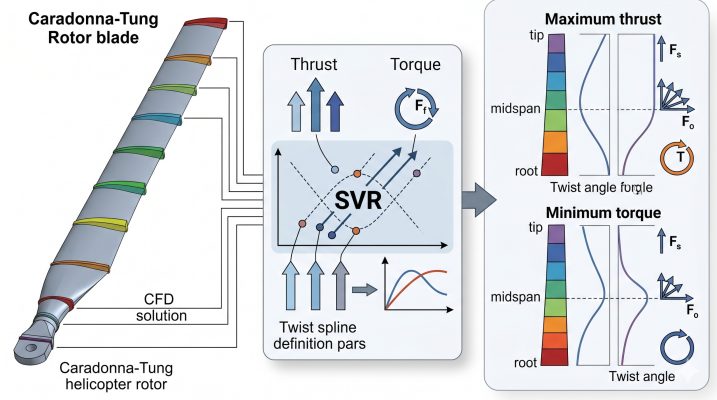
Solving the Reynolds Averaged Navier-Stokes (RANS) equations is essential for an accurate estimation of the aerodynamic loads on the helicopter rotor blades. This is highly time consuming process, especially, in the case of blade shape optimization in which several RANS solutions are obtained using Computational Fluid Dynamics (CFD) solvers. A recent approach to diminish the duration of computation is to employ metamodels like machine learning techniques. A well-built metamodel is expected to successfully mimic the CFD solutions. In this study, the Support Vector Regression (SVR) method based on a set of CFD solutions is used as the metamodel. CFD solutions are computed employing the commercial solver, FINE/Turbo by NUMECA International. The support vector regression model is built to give a functional relationship between the spanwise twist and the generated thrust and torque. The smooth variation of twist is defined using a 3-knot cubic spline. A total of 5 parameters are considered as input for the spline definition. The optimum twist distribution is determined according to a baseline blade: the Caradonna-Tung helicopter rotor blade. The following optimization cases are studied: maximum thrust at the experimental torque value and minimum torque at the experimental thrust value. The optimum cases are easily obtained since the SVR provides an analytical model. Results show that it is possible to enhance the blade performance by redistributing the spanwise twist without carrying out a full geometry optimization of the blade shape. Moreover, it has been observed that the twist distribution for both cases show similar behavior from the midspan to the tip while the distribution from the root to the midspan for both cases is totally in contrast.

Previous Post Next Post
CFDMachine Learning

Categories

  • Academic Papers
  • News
  • Technical Articles

Tags

CFD Composite Control Engineering Machine Learning Robotics Satellite Vibration

Recent Posts

  • Attitude Determination and Control Systems (ADCS) of SatellitesMay 19, 2026
  • The Historical Evolution of Attitude Control and the Hardware Architecture of Attitude Determination-Control SystemsMay 19, 2026
  • Mathematical Models, Estimation-Attitude Control Algorithms, and Validation Tests and Simulation InfrastructuresMay 19, 2026
  • SPACROL in the Press: Our Satellite Attitude Simulator SACSTOR Met with Great Interest at SAHA EXPO 2026May 18, 2026
  • Technopreneurship Badge from the Republic of Türkiye Ministry of Industry and Technology to SPACROL’s Deep-Tech Vision!May 18, 2026
Logo

SPACROL develops mission-critical aerospace components and advanced testing systems. Built on Precision. Driven by Control. Designed to Explore.

Links

  • Blog
  • SACSTOR
  • Contact Us

Services

  • Control
  • CFD
  • Design
  • R&D
  • Manufacturing
  • Software

Contact Info

İhsan Doğramacı Blv. Üniversiteler Mah. No:31-20, 06800 Çankaya/Ankara

  • ODTÜ TEKNOKENT BiGG Labsout
  • Email: info@spacrol.com

© Copyright 2026. SPACROL Technology and Industry Inc.

  • Home
  • About
  • Products