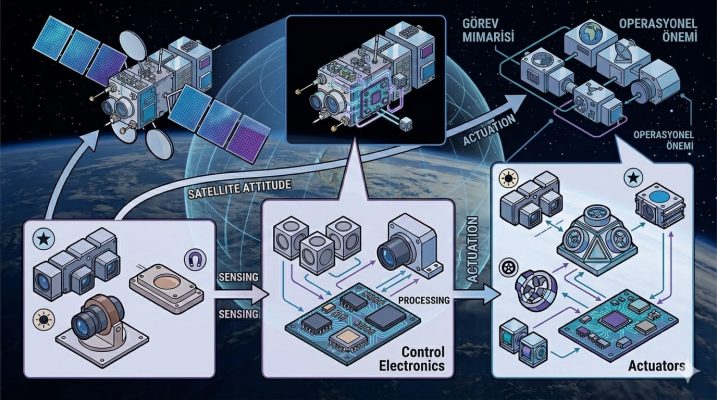
1. Operational Importance of the System and Its Role in Mission Architecture
Spacecraft and artificial satellites must know and control their positions, angular velocities, and attitudes in the vacuum of space with high accuracy to perform their specific missions in orbit successfully and safely. This vital engineering is carried out by an autonomous closed-loop architecture called the Attitude Determination and Control System (ADCS), where advanced sensors, actuators, and complex mathematical algorithms operate in an integrated manner [1]. The attitude of a spacecraft refers to the angular orientation of the coordinate system fixed to the vehicle’s own body (body frame) relative to an inertial reference system in space (inertial frame) or specific celestial bodies such as the Earth, Sun, and Moon [3].
The success of a space mission depends largely on the pointing accuracy and stability provided by the ADCS [6]. System design is shaped according to the payload carried by the satellite and the requirements of its communication infrastructures. For example, in deep space missions, the spacecraft’s high-gain antennas must be perfectly aligned with ground stations on Earth to establish and maintain data communication [2]. Similarly, platforms like NASA’s Earth observation satellites Aqua or GRACE-FO (Gravity Recovery and Climate Experiment Follow-On) must continuously keep their scientific instruments pointed in the nadir (towards the center of the Earth) direction to track the planet’s gravity anomalies and climate changes [9]. For platforms conducting astronomical observations, such as the Hubble Space Telescope, the importance of ADCS reaches a much more critical level. In order for Hubble to image galaxies millions of light-years away without jitter, it needs an extraordinary stabilization of 0.007 arc-seconds; in practical terms, this precision means that a laser beam located in Washington D.C. can remain locked onto a coin on the Empire State Building in New York for hours without deviating [11].
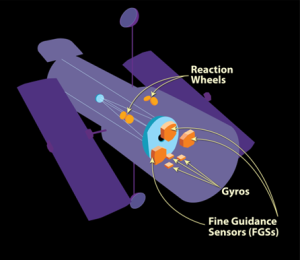
The components of Hubble’s Pointing Control System are labeled in this image. [11]
In addition to the pointing function, ADCS is also directly responsible for the thermal balance and energy management required for the spacecraft’s survival. The solar panels of satellites must track the Sun along the orbit to generate maximum electrical energy [14]. At the same time, the satellite is maintained in a specific thermal attitude or performs a slow barbecue roll to prevent the massive temperature differences between the dark and sunlit surfaces of the spacecraft from damaging sensitive electronic components [8]. In the event of any hardware or software failure, the satellite entering an uncontrolled tumbling state can lead to the panels being unable to see the Sun and the batteries rapidly depleting, resulting in a total loss of the mission. When such anomalies are detected, the ADCS autonomously activates a survival protocol called “Safe Hold Mode.” In this mode, all non-critical systems, such as scientific payloads, are shut down, the spacecraft is oriented toward the Sun to maximize energy production, and recovery commands from the ground control station are awaited [14]. The MAVEN (Mars Atmosphere and Volatile EvolutioN) spacecraft in Mars orbit entering safe mode after degradations in its Inertial Measurement Unit (IMU) and then returning to scientific operations with a new autonomous navigation strategy based entirely on star tracker data is a striking example of the mission-saving flexibility of ADCS [19].
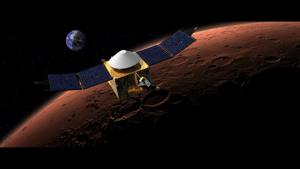
This illustration shows the MAVEN spacecraft orbiting the Red Planet, along with an imaginary view of planet Earth. (Courtesy of NASA/GSFC) [19]