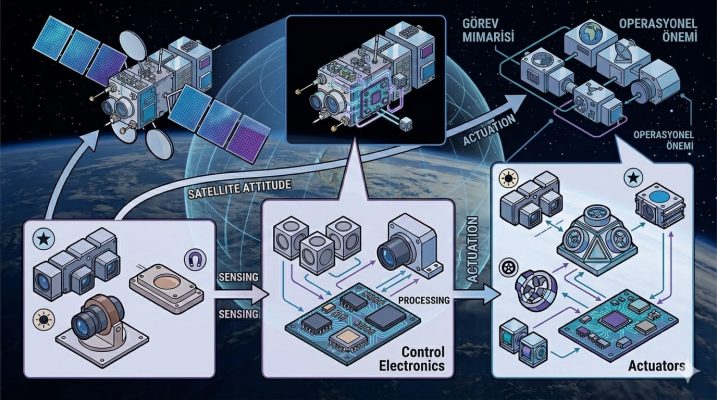
Attitude Determination and Control Systems (ADCS) of Satellites
1. Operational Importance of the System and Its Role in Mission Architecture Spacecraft and artificial satellites must know and control their positions, angular velocities, and attitudes in the vacuum of space with high accuracy to perform their specific missions in orbit successfully and safely. This vital engineering is carried out by an autonomous closed-loop architecture […]
Read More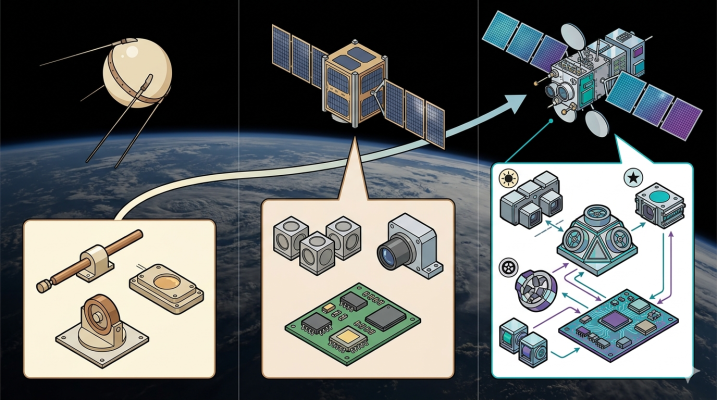
The Historical Evolution of Attitude Control and the Hardware Architecture of Attitude Determination-Control Systems
Table of Contents 1. Historical Evolution of Attitude Control 2. Hardware Architecture of the Attitude Determination and Control System 2.1. Attitude Determination Sensors 2.2. Attitude Control Actuators 1. Historical Evolution of Attitude Control Attitude determination and control technologies have undergone an extraordinary engineering evolution from the dawn of the space age to today’s constellation concepts. […]
Read More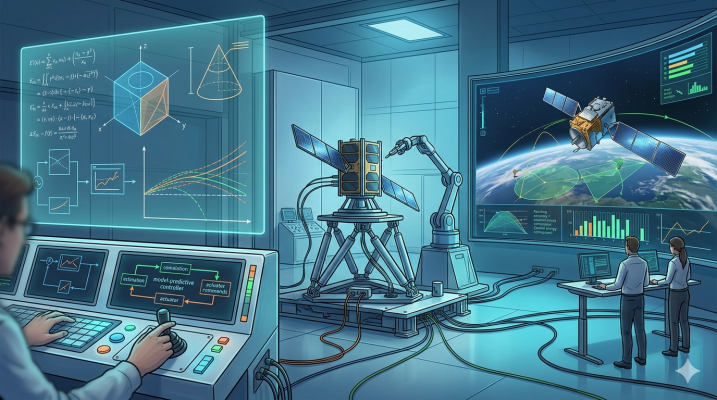
Mathematical Models, Estimation-Attitude Control Algorithms, and Validation Tests and Simulation Infrastructures
Table of Contents 1. Mathematical Models, Estimation and Attitude Control Algorithms 2. Terrestrial Verification Tests and Simulation Infrastructures 2.1. Spherical Air Bearings 2.2. Magnetic Simulators: Helmholtz Cages and NASA Facilities 3. General Evaluation and Future Perspectives 1. Mathematical Models, Estimation and Attitude Control Algorithms To orient the satellite in the desired direction, data from sensors […]
Read More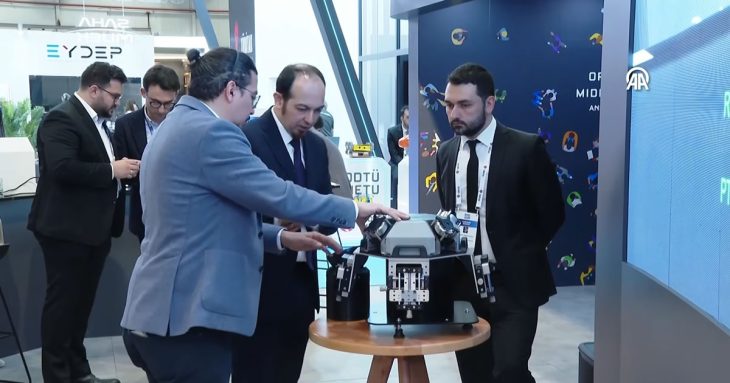
SPACROL in the Press: Our Satellite Attitude Simulator SACSTOR Met with Great Interest at SAHA EXPO 2026
Our indigenous satellite attitude simulator SACSTOR, which we showcased for the first time at SAHA EXPO 2026 with the aim of ending foreign dependency in satellite testing processes, has made a massive impact in the defense and aerospace ecosystem as well as in the national press. While this innovative deep-tech product we developed was examined […]
Read More
Technopreneurship Badge from the Republic of Türkiye Ministry of Industry and Technology to SPACROL’s Deep-Tech Vision!
Our commitment to developing indigenous, high-value-added, and mission-critical space and aerospace subsystems has been officially recognized at the highest governmental level. Following a rigorous evaluation and technical audit conducted by the Republic of Türkiye Ministry of Industry and Technology, SPACROL has been awarded the “Technopreneurship Badge” (Teknogirişim Rozeti), one of the most prestigious insignias in […]
Read More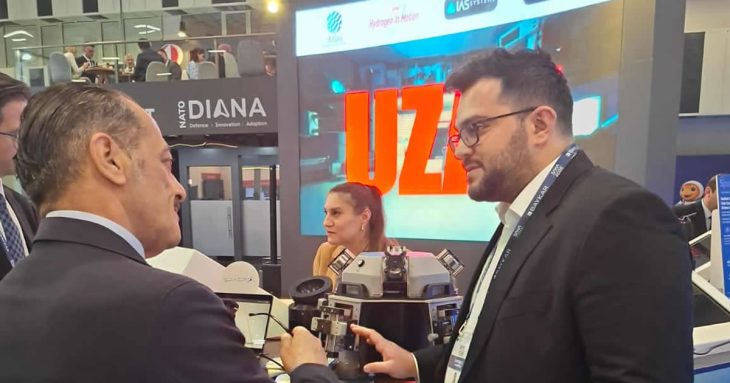
Introducing Our New Solutions in Space and Defense Technologies at SAHA EXPO 2026
We proudly presented our 3 new products—whose R&D processes were successfully completed in our laboratories at ODTÜ Teknokent—to industry professionals for the first time at SAHA EXPO 2026. These products are developed to provide direct solutions to the operational needs of the defense and aerospace sectors.
Read More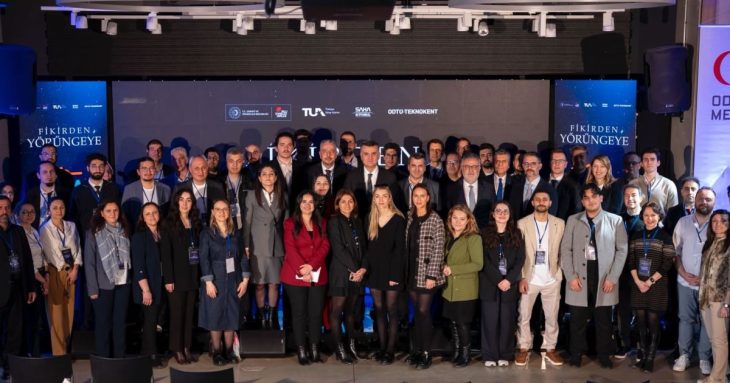
From Idea to Orbit: SPACROL Takes Its Place at the Space Tech Startups Meetings
As SPACROL, we proudly took our place at the “From Idea to Orbit: Space Tech Startups – Corporate Meetings” event, held at ODTÜ Teknokent on February 17, 2026, aimed at further advancing Turkey’s space and aerospace ecosystem. Coordinated by the Ministry of Industry and Technology and realized in valuable partnership with the Turkish Space Agency […]
Read More
SPACROL Awarded the “Seal of Excellence” and Investment in TÜBİTAK BİGG 2024 Call!
Our innovative and mission-critical subsystems developed for the aerospace industry have been officially recognized by TÜBİTAK BİGG (Individual Young Entrepreneur), one of Turkey’s most prestigious entrepreneurship programs. As SPACROL, we are proud to announce that we have successfully completed the rigorous evaluation processes of the BiGG Investment 2024 1st Call, earning the prestigious “Seal of […]
Read More
Design of Sandwich Structures for High Vibration and Noise Conditions
Sandwich materials that are considered to have lightweight, well-flexural behavior, in addition to relatively high structural damping are considered significant by aerospace sectors due to the usage of such materials in specific aircraft applications including helicopter interior parts where vibrations and noises of high levels take place. The primary purpose of the research is to concentrate on sandwich structures with high damping values and appropriate flexural rigidity.
Read More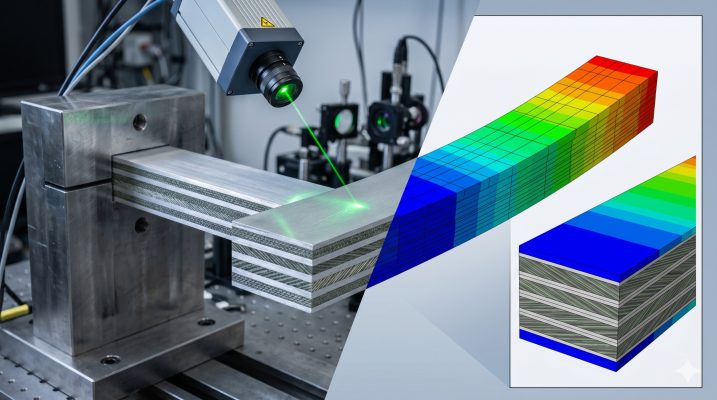
Experimental and numerical vibration analysis of GLARE beams
In this paper, the dynamic behavior of glass-reinforced aluminum laminate epoxy (GLARE) beams was examined via experimental and numerical methods. Four beams were manufactured with different fiber orientations and tests were conducted by using a non-contact experimental setup with clamped-free boundary conditions. It was found that different fiber orientations have effects on the natural frequencies of the beams.
Read More