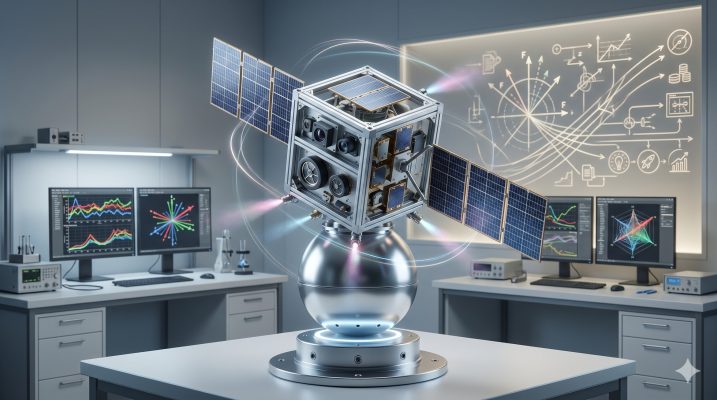
A Review Paper: The Dynamics, Kinematics, Design and Control of Satellite Simulators with Spherical Air Bearing
Authors: Ramazan Yeşilay, Arif Ankaralı, Mustafa Atakan Afşar
Conference/Journal: Global Conference on Engineering Research
Publication Date: 02.06.2021
Abstract:
Because of the high cost and the long-life requirements of the satellites, they are subjected to various tests on ground before launching. So that all the units assembled to the satellite are tested and checked if they are working properly. The space conditions like near zero friction must be satisfied in the laboratory so that the satellite’s orientation controls may be studied. For this reason, different types of simulators are utilized to test these space devices. Spherical air bearing simulators which are often used for checking and validating the attitude control systems are used to simulate only the frictionless space environment where different types of external disturbances are also available. Attitude control systems use different type of actuators that change the orientation of the satellite with the help of the information received from the sensors. In this paper, simulators with spherical air bearing used for testing the attitude control systems available in the literature are examined. Many challenges are encountered that may adversely affect the working conditions during the process from design to manufacturing of the spherical air bearings. Moreover, it is observed that, modeling of the attitude control systems together with the disturbances are also be taken into consideration. So, the required studies from numerical simulations to the ground tests are carefully planned to check the behavior of the attitude control systems. Aim of this study is to make a survey on the dynamic and kinematic analysis, attitude control methods and disturbances on the different types of ground test simulators and various friction models present in the literature. The studies that have contributed to the literature and based on the attitude control systems on simulators, especially in the last 15 years, are examined.