
Design of Sandwich Structures for High Vibration and Noise Conditions
Sandwich materials that are considered to have lightweight, well-flexural behavior, in addition to relatively high structural damping are considered significant by aerospace sectors due to the usage of such materials in specific aircraft applications including helicopter interior parts where vibrations and noises of high levels take place. The primary purpose of the research is to concentrate on sandwich structures with high damping values and appropriate flexural rigidity.
Read More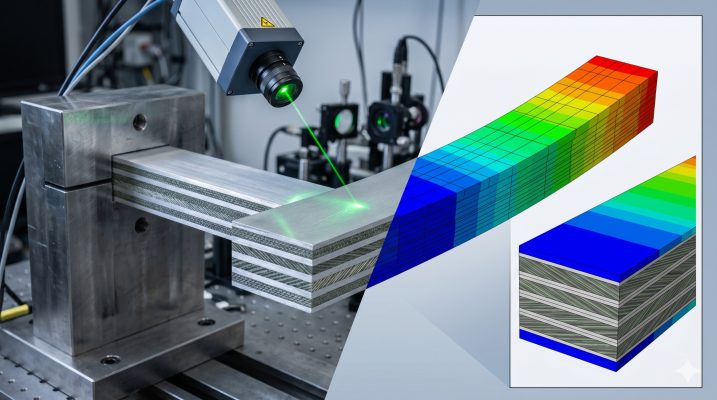
Experimental and numerical vibration analysis of GLARE beams
In this paper, the dynamic behavior of glass-reinforced aluminum laminate epoxy (GLARE) beams was examined via experimental and numerical methods. Four beams were manufactured with different fiber orientations and tests were conducted by using a non-contact experimental setup with clamped-free boundary conditions. It was found that different fiber orientations have effects on the natural frequencies of the beams.
Read More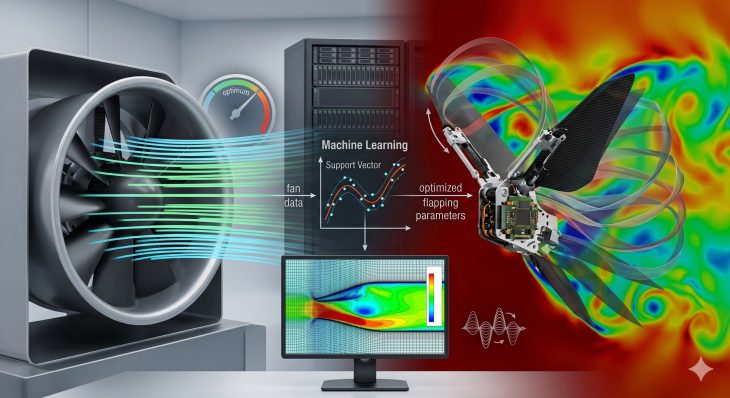
Investigation of Flapping Wings as an Alternative to Axial Flow Fans
Flapping wings appear to be an innovative approach as an alternative to axial flow fans. In this study, the flapping motion has been defined as a linear combination of pitching and plunging. Both pitch and plunge motions have been given as sinusoidal in time with a phase shift between them.
Read More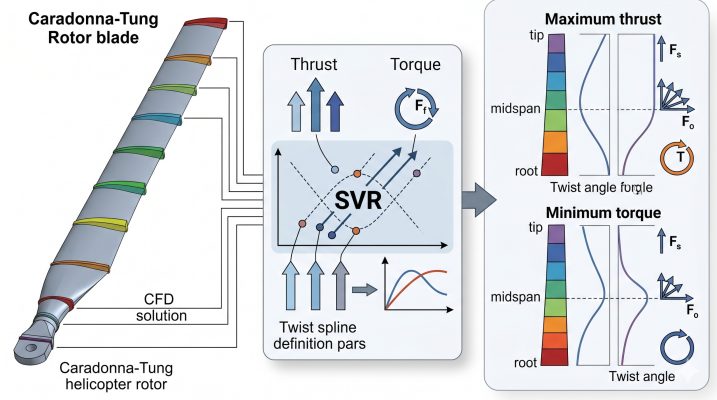
Twist Optimization of a Helicopter Rotor Blade Using Support Vector Regression
Solving the Reynolds Averaged Navier-Stokes (RANS) equations is essential for an accurate estimation of the aerodynamic loads on the helicopter rotor blades. This is highly time consuming process, especially, in the case of blade shape optimization in which several RANS solutions are obtained using Computational Fluid Dynamics (CFD) solvers. A recent approach to diminish the duration of computation is to employ metamodels like machine learning techniques.
Read More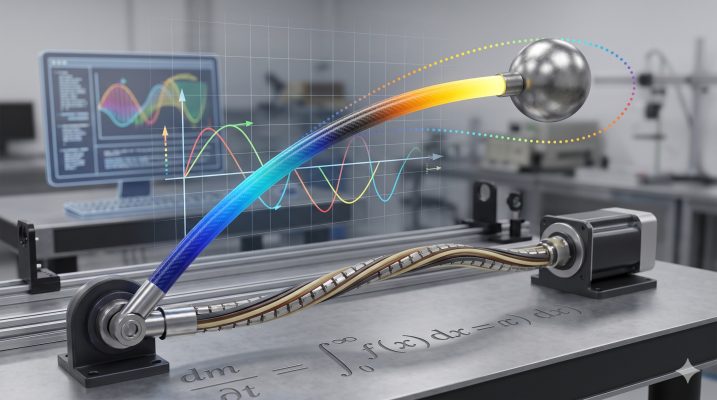
Mathematical Modeling and Simulation of a Flexible Shaft-Flexible Link System with End Mass
In this study, the equation of motion of a single link flexible robotic arm with end mass, which is driven by a flexible shaft, is obtained by using Hamilton’s principle. The physical system is considered as a continuous system. As a first step, the kinetic energy and the potential energy terms and the term for work done by the nonconservative forces are established.
Read More
Vibration Control of an Elastic Manipulator Link
The R factors employed in crystal structure analysis can also be used in connection with clay minerals to determine the amount of defects whose types are already known. For this purpose, using the unit-cell parameters of kaolinite with identical layers,(02, 11) and (20, 13) diffraction bands were calculated on the basis of a variable parameter model containing only+ b/3 translational stacking faults.
Read More
A Review Paper: The Dynamics, Kinematics, Design and Control of Satellite Simulators with Spherical Air Bearing
Because of the high cost and the long-life requirements of the satellites, they are subjected to various tests on ground before launching. So that all the units assembled to the satellite are tested and checked if they are working properly. The space conditions like near zero friction must be satisfied in the laboratory so that the satellite’s orientation controls may be studied. For this reason, different types of simulators are utilized to test these space devices.
Read More
Optimizing PID Gains of a Vehicle using the state-of-the-art Metaheuristic Methods
PID controllers are important control methods that are widely used in industrial processes. Proper tuning of PID gains is critical for achieving the state-of-the-art system performance. Therefore, optimizing PID gains is an important research topic in the field of control engineering. In this study, PID controller gains are automatically tuned using metaheuristic optimization methods. These methods use an iterative approach to calculate optimal values of PID controller gains based on different optimization techniques.
Read More